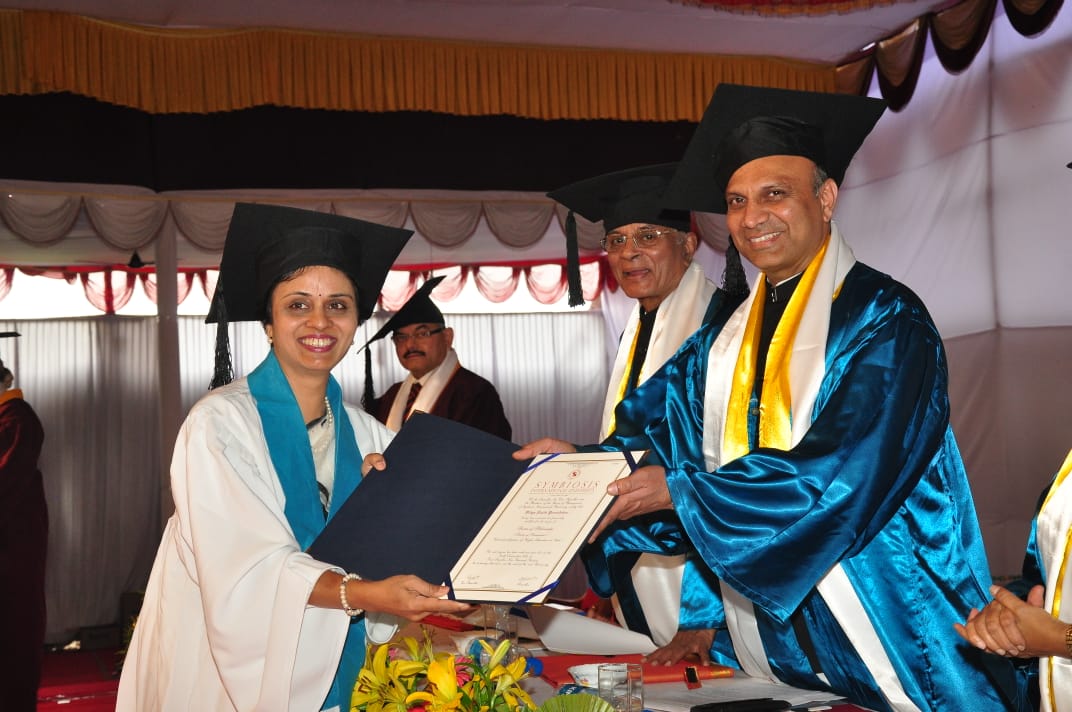
Yesterday, at the 22nd convocation of Symbiosis International University, I stood on stage watching PhD students receive their degrees. That moment transported me down memory lane and prompted me to pause, reflect, and revisit my own PhD journey.
I completed my MD in Obstetrics and Gynaecology in 1989 and practiced as a gynaecologist for more than a decade, both in India and abroad. Clinical practice was deeply fulfilling, but life gradually led me in a different direction. I joined my father and became immersed in the world of education—an ecosystem that would eventually shape my academic and professional purpose.
While I was involved in the educational administration of Symbiosis, my heart always lay in internationalisation. This inclination was shaped very early in life. I grew up in a home where my parents looked after foreign students who were distressed and far from home in Pune. In many ways, Symbiosis was born in our house—with the simple yet powerful objective of bringing Indian and international students closer to one another. Growing up in such an environment naturally shaped my worldview.
Over time, I realised that internationalisation was far more than student exchanges or global exposure. It was about mutual respect, cultural understanding, and the sharing of ideas across borders. This deeper understanding eventually drew me towards serious academic inquiry and culminated in my decision to pursue a PhD.
My PhD journey, however, was not an easy one. Managing institutional responsibilities, administrative work, and academic research simultaneously left very little time for conventional research activities—such as extensive reading, structured literature reviews, or prolonged academic interactions.
What supported me immensely was my association with the University Grants Commission (UGC). Being a member gave me access to important policy documents, which became the foundation of my literature review. Through this, I gained deep insights into where India stood in terms of internationalisation and what new dimensions could be introduced.
Interestingly, my UGC-related travel became a blessing in disguise. The uninterrupted two hours on flights—each way—provided me with focused, disturbance-free time to read, reflect, and research. Those quiet hours in the air became some of my most productive research moments.
To every student aspiring to pursue a PhD, I always offer one piece of advice: choose a topic you are genuinely passionate about and deeply involved in. Do not chase fashionable or “fancy” topics due to peer pressure. Research is ultimately about discovering something new or finding solutions to existing problems. To do that meaningfully, one must know the subject well enough to identify gaps and add value.
For me, internationalisation of higher education was not just an academic interest—it was a lifelong passion. I strongly believed that India needed to do much more in this space. When I completed my PhD in 2013 on the internationalisation of higher education in India, I felt a responsibility to take the research beyond the thesis. This led to converting my work into a book, which was eventually published by SAGE. I am happy that the book now serves as a reference point for policy formulation.
It is especially gratifying to see that internationalisation has been given due importance in the National Education Policy. I am glad that, in my own small way, I could contribute to this evolving discourse.
For me, a PhD is not merely about acquiring a degree or the title of “Doctor.” It is about inquiry, contribution, and impact—about adding value to existing knowledge, influencing policy, and leaving behind something meaningful for the academic and professional community.
Standing at the convocation yesterday, watching young scholars step forward, I felt a deep sense of gratitude—for the journey, the mentors, the institution, and the enduring belief in lifelong learning.