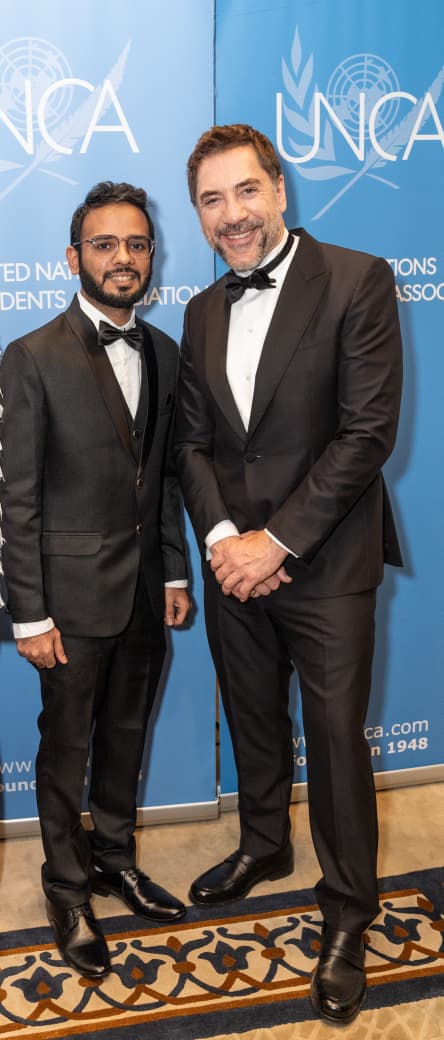
Journalism has emerged as a powerful force in shaping public understanding of climate geopolitics, holding governments accountable, and amplifying voices from vulnerable regions. I feel proud of the impact of climate journalism, especially the global recognition received by Sanket Jain, an alumnus of Symbiosis Centre for Media & Communication (SCMC), Batch of 2017. Sanket Jain won one of the most prestigious international awards for journalism—the United Nations Gold Medal in the Climate Change category. The award ceremony took place at the United Nations Headquarters in New York, where he was presented the medal by acclaimed Hollywood actor and UN Global Ambassador Javier Bardem.
This recognition highlights the growing importance of credible, impactful storytelling in the climate discourse. Journalism that rigorously examines the intersection of environment, power, and policy plays a vital role in shaping global awareness and influencing decision-making at the highest levels. In a world grappling with climate-driven geopolitical shifts, such work serves as a bridge between data, diplomacy, and public conscience.
Climate change is no longer only an environmental concern; it has become one of the defining geopolitical forces of the 21st century. Rising temperatures, extreme weather events, shrinking natural resources, and displacement of populations are reshaping relations between nations, altering power balances, and redefining what security means in a rapidly changing world. As the climate crisis deepens, it is increasingly clear that environmental challenges and global politics are now inseparable.
At the heart of the geopolitics of climate change lies inequality. Nations that have contributed the least to global emissions often bear the heaviest consequences. Small island states face existential threats from rising sea levels, while parts of Africa and South Asia confront food insecurity, water stress, and climate-induced migration. Meanwhile, industrialized countries that historically benefited from carbon-intensive growth hold greater financial and technological capacity to adapt. This imbalance fuels diplomatic tensions and places climate justice at the center of international negotiations.
Climate change is also redefining global power structures. Control over critical resources—such as water, rare earth minerals, and clean energy technologies—has become strategically important. Countries leading the transition to renewable energy and green innovation are positioning themselves as future power hubs, while those heavily dependent on fossil fuels face economic and political recalibration. The shift toward green economies is not merely an environmental transition; it is a strategic contest over influence, markets, and leadership.
Security considerations further complicate the climate equation. Climate-induced disasters exacerbate existing conflicts, strain fragile states, and increase the likelihood of cross-border tensions. Migration driven by droughts, floods, and rising sea levels is emerging as a major geopolitical issue, challenging national borders and humanitarian frameworks alike. Increasingly, climate change is viewed by defense and policy establishments not as a distant risk but as a “threat multiplier” that amplifies instability.
Ultimately, the geopolitics of climate change demands collective leadership rather than competitive posturing. No nation can insulate itself from a warming planet, and no geopolitical advantage can outweigh the costs of inaction. Cooperation, transparency, and shared responsibility will determine whether climate change becomes a source of prolonged conflict or an opportunity for unprecedented global collaboration.
As the climate crisis continues to redraw the world map—economically, politically, and morally—the choices made today will shape international relations for generations to come. The challenge is not merely to manage climate change, but to reimagine global leadership in a way that places sustainability, equity, and shared survival at its core.