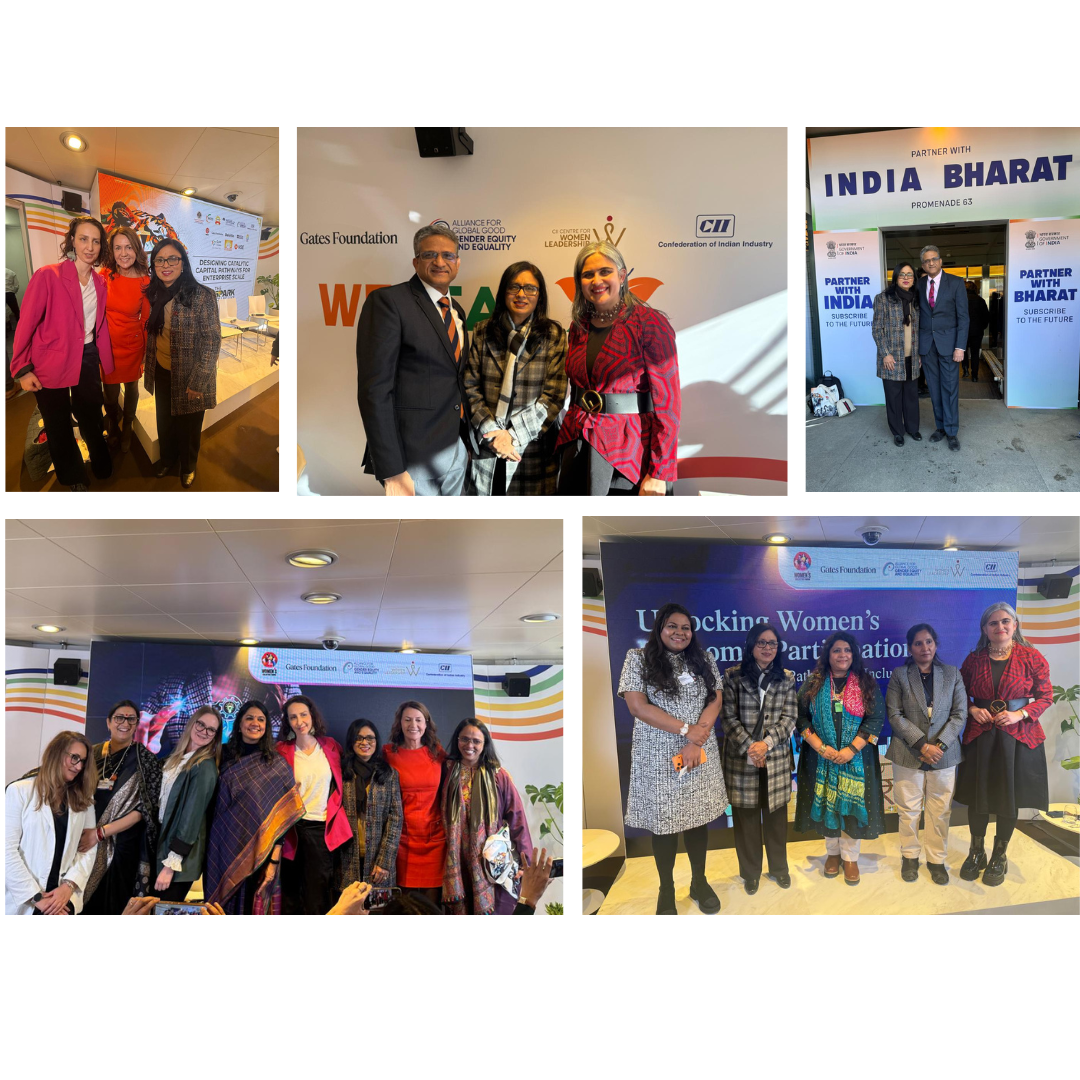
I had always heard of Davos — that quaint, quintessential Swiss town tucked away in the snow-capped Alps. For most of us, Davos exists in the imagination as the venue of the World Economic Forum (WEF), an annual gathering that brings together Heads of State, diplomats, CEOs, global thinkers, and academicians. Honestly, I was fascinated by what actually happens there and why it draws so much global attention year after year. What are the outcomes from these high-power conversations that unfold amidst the winter chill?
Long before I had the opportunity to see Davos with my own eyes, I had heard stories about the Forum from the late Mr. Rahul Bajaj during informal conversations at get-togethers in Pune. I had little idea then that someday I would not only visit Davos but also speak at two sessions organized by the Confederation of Indian Industry (CII) on women’s empowerment.
And what an experience it was!
Thank you, Mr. Sanjiv Bajaj and Mr. Banerjee, for extending the invitation.
This year’s WEF was remarkable for India. “Team India” made one of its largest ever representations, with a delegation that included Union ministers, chief ministers, over 80 CEOs and leaders from Indian industry, and many voices from Maharashtra — all converging on that single promenade that is Davos’s main street.
While Davos may be just one street you can walk from end to end in half an hour, every inch of that street buzzed with purpose and possibility. Walking through it felt like stepping into a global marketplace of ideas, partnerships, and investments, and — hearteningly — encountering so many Indians engaged, connecting, and collaborating added a profound sense of pride.
This year, India didn’t just participate, various State Governments made concrete investment waves.
Beyond individual state commitments, India’s national narrative at Davos underscored its accelerating transition to cleaner energy, with more than 52 % of installed power capacity now from non-fossil sources (267 GW) — a key talking point in energy financing and climate sessions. 
At a broader level, discussions and sessions repeatedly positioned India as an inevitable third-largest global economy, highlighting not just growth projections but the quality of that growth and its translation into jobs, industry and technological leadership.
What was particularly striking was the diversity of Indian participation: from life sciences and AI innovation hubs pitched by Telangana, to Karnataka’s broad engagements, and Uttar Pradesh’s mega-MoUs — it felt more like a mini-India summit within Davos than passive attendance. 
For someone who had only read about Davos, experiencing it firsthand helped crystallise why it matters:
It’s an extraordinary networking crucible where policymakers meet investors and industry leaders. It’s a deal-generation platform, not just a discussion forum — as seen in the flurry of MoUs and investment proposals. It’s a place where narratives are shaped, from climate and AI to economic growth trajectories.
And yes — despite Davos’s compact size, its global convening power is immense.
Walking through Davos, stepping into sessions with world leaders, and seeing India’s story being heard, debated and invested in — it was beyond exhilarating. This wasn’t just a business trip; it was a moment where aspirations met opportunity, where ideas were backed by real capital, and where every handshake felt like a bridge to future growth.
It was, without a doubt, one of the most memorable experiences of my life.